
MSME
Registered

Wedline
Registered

We Deliver
Clutch

28+ Reviews

250+ Projects
Completed

125+ Happy
Clients
MSME
Registered
Wedline
Registered
We Deliver
Clutch
28+ Reviews
250+ Projects
Completed
125+ Happy
Clients
Date: 08-05-2026
India alone needs to skill over 400 million people this decade to meet industry demand. Yet employers consistently report that they cannot find job ready candidates, while millions of youth complete training programs and still struggle to find work. The problem is not a lack of effort. It is a lack of connection between what is taught, how it is assessed, and what employers actually need on day one.
Traditional vocational training often operates in silos. Training centers deliver curriculum designed years ago. Assessments are paper based and disconnected from workplace tasks. Placement happens through occasional job fairs and personal contacts. There is little data on who got hired, how long they stayed, or what skills predicted success. Without this feedback loop, the gap between skills and employment persists.
Vocational training platforms change this equation. They bring learners, trainers, assessors, and employers onto a single digital system where skills are taught, measured, and matched to real opportunities. At BM Coder, a software development company focused on workforce technology, we build these end to end systems through our skill development platform software practice. The goal is simple: make every hour of training count toward a verifiable job outcome.

Four structural issues create the gap. First, curriculum lag. Industry needs change every 12 to 18 months, but course content updates every few years. Second, assessment mismatch. Written tests do not predict job performance as well as practical, work sample assessments. Third, poor visibility. Employers cannot see verified skills, and learners cannot see which jobs match their profile. Fourth, weak follow through. Placement is treated as a one time event, not as a 90 day onboarding journey with support.
These issues are compounded by fragmented data. Attendance lives in registers, assessments in spreadsheets, certifications on paper, and placements in WhatsApp groups. Without unified data, no one can improve the system systematically.

A modern platform is not just an LMS. It is an operating system for skills to jobs. It manages the entire learner journey from mobilization and enrollment to training delivery, competency assessment, certification, job matching, placement, and post placement tracking.
For training providers, it offers curriculum management, blended learning delivery, attendance tracking with geo tagging, and trainer performance analytics. For assessors, it provides digital assessments, practical evaluations with rubrics, and secure proctoring. For employers, it offers a talent marketplace with verified skill profiles, not just resumes. For program funders and government bodies, it delivers transparent dashboards on enrollments, completions, placements, and retention.
Platforms ingest live job data from employer partners and public sources to identify in demand skills, tools, and certifications. Curriculum teams update modules quarterly, not every three years. Employers co create capstone projects that mirror real tasks, ensuring learners practice what they will do on the job.
Completion certificates are weak signals. Competency profiles are strong signals. Platforms use skill taxonomies, practical assessments, and work samples scored against rubrics. A learner in electrician trade is assessed on wiring a distribution board safely within time, not just on theory. The result is a verified skill passport that employers trust.
Each learner gets a digital profile showing courses, attendance, assessment scores, projects, badges, and soft skills ratings from trainers. Profiles are portable and shareable with employers via a secure link or QR code. This reduces hiring risk and speeds shortlisting.
Matching algorithms compare learner competencies, location preferences, and availability with job requirements, not just keywords. A retail sales role requiring POS billing, basic English, and morning shifts matches only candidates who have demonstrated those skills. This improves interview to offer ratios dramatically.
Employers post roles, define skill requirements, review matched candidates, schedule interviews, and provide feedback, all inside the platform. This closed loop generates data on which skills predict success, which training centers produce the best hires, and where curriculum needs improvement.
Placement does not end at offer letter. Platforms track joining, 30 day check ins, 90 day retention, and salary progression. Automated nudges support learners through onboarding challenges. If a learner drops out, the system captures reasons and triggers re skilling or counseling.
With unified data, program leaders see which trades have high placement, which trainers drive better outcomes, and which assessment items predict job success. They reallocate seats, update content, and coach trainers based on evidence, not anecdotes.

| Challenge | Traditional Approach | Platform Solution | Outcome |
|---|---|---|---|
| Outdated curriculum | Annual updates | Quarterly updates from live job data | Higher relevance, better placement |
| Weak assessment | Theory exams | Practical, rubric based, proctored | Trusted skill signals |
| Poor employer visibility | Resumes via email | Verified skill profiles and matching | Faster hiring, lower cost |
| Low retention post placement | No follow up | 30-60-90 day tracking and support | Higher 90 day retention |
| Fragmented reporting | Spreadsheets | Unified dashboards for funders | Transparency and scale |
| Module | Key Capabilities | Primary Users | Business Value |
|---|---|---|---|
| Mobilization and Enrollment | Lead capture, eligibility checks, eKYC, counseling | Mobilizers, counselors | Higher conversion to enrollment |
| Learning Delivery | Blended LMS, attendance, assignments, labs | Trainers, learners | Better completion rates |
| Assessment and Certification | Question banks, practical rubrics, proctoring, badges | Assessors, certifying bodies | Credible credentials |
| Talent Marketplace | Skill profiles, job matching, interview scheduling | Employers, placement officers | Faster time to hire |
| Placement and Alumni Tracking | Offer management, onboarding checklists, retention surveys | Placement teams, alumni | Improved retention and wages |
| Analytics and Compliance | Outcome dashboards, fund utilization, audit trails | Leadership, funders | Transparency and funding |
Aspirants discover programs through a mobile app or community mobilizer. They complete a short skill and interest assessment, upload documents, and receive course recommendations aligned to local job demand. Enrollment is paperless with eKYC and digital consent.
During training, attendance is marked via QR or biometric integration, assignments are submitted digitally, and practicals are recorded for assessor review. Trainers receive real time alerts for at risk learners based on attendance dips or low quiz scores, enabling early intervention.
Assessment combines theory, practical, and soft skills. For a healthcare assistant, this includes infection control procedures, patient communication role plays, and vital signs measurement. Scores feed into a skill passport with levels like foundational, proficient, and advanced.
Placement begins before course end. The platform surfaces matched jobs, helps learners build a video introduction, and schedules interviews. Employers see verified skills, not just claims. After joining, the learner receives check in nudges, access to peer mentors, and upskilling suggestions based on early performance feedback.
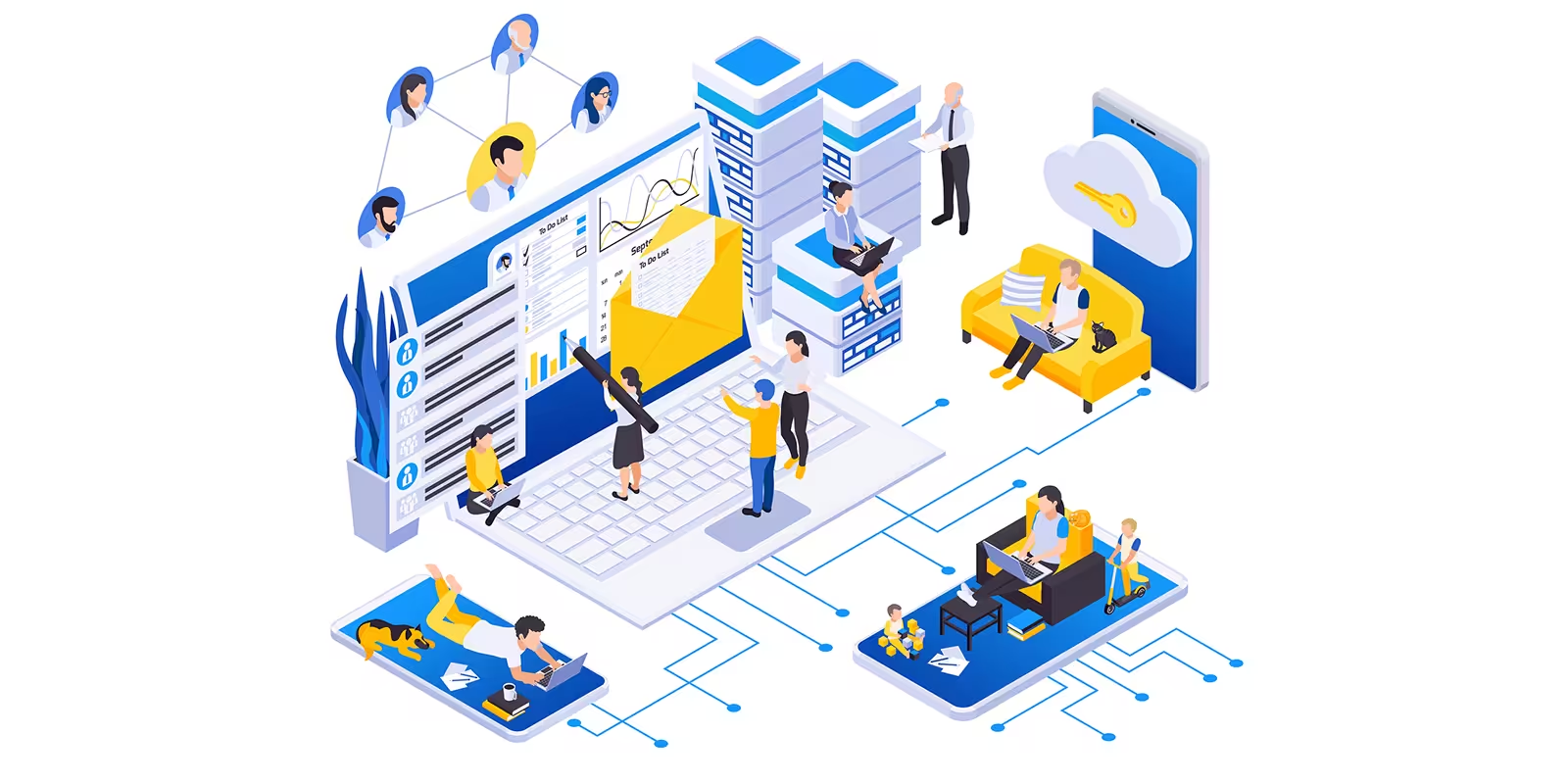
Employers adopt platforms when hiring becomes easier, not harder. Key features include single sign on, role based access for recruiters, bulk job posting via API, and standardized skill requirements mapped to your taxonomy. Interview feedback is captured in structured forms, creating data to refine matching.
For high volume roles in retail, logistics, and BFSI, employers can set auto shortlisting rules. Candidates meeting competency thresholds are automatically invited for assessments or interviews. This reduces time to hire from weeks to days.
A robust platform centers on a unified learner record. It links mobilization data, learning activity, assessments, certifications, job applications, offers, joining, and retention. This longitudinal record powers analytics and personalization.
Skill taxonomies should align to national frameworks like NSQF in India, with mappings to job roles and employer specific requirements. This ensures portability and recognition. All data is protected with role based access, encryption, and consent management, especially important for youth data.
AI is useful when it solves specific bottlenecks. Resume parsing and skill extraction speed profile creation. Matching models improve interview conversion. Chatbots answer common learner queries about schedules and documents in local languages. Computer vision can assist in practical assessments, for example checking PPE compliance in a lab video.
Automation handles reminders for attendance, fee payments, document expiry, and follow up surveys. This reduces manual coordination and improves completion and retention rates.
Move beyond vanity metrics like enrollments. Track the full funnel: mobilization to enrollment conversion, attendance rate, assessment pass rate, certification rate, interview rate, offer rate, joining rate, 30 day retention, 90 day retention, and median first salary. Break these down by trade, center, trainer, and employer.
Cost per placement and cost per retained placement are critical for funders. Time to first job measures speed to outcome. Employer satisfaction and repeat hiring indicate quality. These metrics should be visible in real time dashboards, not quarterly reports.
Building an LMS only. Without assessment, matching, and placement tracking, you will not bridge the gap. Ignoring offline realities. Field centers need offline capable apps and simple UX. Over collecting data. Collect only what drives decisions and reporting. Neglecting employer experience. If recruiters find it cumbersome, adoption fails. Treating placement as the end. Retention and wage progression are the true measures of success.
Retail and Customer Service: Platforms that include POS simulations, spoken English practice with speech scoring, and mystery shopping style assessments achieve placement rates above 70 percent and 90 day retention above 65 percent.
Healthcare Assistants: Combining video based practicals, infection control checklists, and hospital partner co designed capstones leads to faster onboarding and fewer early dropouts.
IT Support and Digital Skills: Hands on labs in a browser, ticketing simulations, and employer defined troubleshooting scenarios produce job ready candidates in 10 to 12 weeks.
Manufacturing and Electrical Trades: AR guided wiring tasks, safety compliance checks, and time bound practicals create credible skill signals that employers trust.
For government funded programs, align with scheme guidelines on attendance, assessments, and reporting. Build audit trails for every critical action. Provide role based dashboards for NSDC, state missions, or CSR funders. Ensure data privacy with consent, purpose limitation, and retention policies. For international standards, support integrations with credentialing bodies and digital badge standards.

BM Coder brings deep experience in building workforce platforms that work in the real world, not just in demos. We design for low bandwidth environments, multilingual users, and mobile first field teams. Our engineering covers the full stack: learner apps, trainer portals, employer dashboards, assessment engines, matching algorithms, and analytics.
We partner closely with training providers, employers, and funders to co create the taxonomy, assessments, and workflows that drive outcomes. Security, scalability, and maintainability are built in from day one, with SSO, RBAC, and robust APIs for integration with existing systems.
Talk to BM Coder about your vocational training platform roadmap.
Email: [email protected]
WhatsApp: +91.9586979730
The next wave of vocational platforms will feature AI tutors for personalized remediation, digital twins of workplaces for safe practice, and verifiable credentials stored in learner wallets. Labor market intelligence will automatically update curricula as job requirements evolve. Most importantly, platforms will measure and optimize for career progression, not just first job placement, supporting learners through upskilling pathways over years.
Vocational training platforms bridge the gap between skills and employment by aligning curriculum to market demand, measuring real competency, creating trusted skill profiles, matching learners to the right jobs, and supporting them through onboarding and retention. They replace fragmented processes with a unified system where every stakeholder sees what they need and data flows seamlessly from classroom to workplace.
If you are a training provider, employer consortium, government mission, or CSR foundation looking to improve placement outcomes, investing in a purpose built platform is the highest leverage step you can take. BM Coder is ready to help you design, build, and scale a system that turns training hours into meaningful careers.
Author: parth
