
MSME
Registered

Wedline
Registered

We Deliver
Clutch

28+ Reviews

250+ Projects
Completed

125+ Happy
Clients
MSME
Registered
Wedline
Registered
We Deliver
Clutch
28+ Reviews
250+ Projects
Completed
125+ Happy
Clients
Date: 20-03-2026
Modern healthcare relies heavily on timely and accurate medical imaging for diagnosis and treatment planning. Radiology departments are at the core of this process, handling vast volumes of imaging data every day, including X-rays, CT scans, MRIs, and ultrasounds. Traditionally, storing, accessing, and sharing this data has been a challenge. Enter the PACS Medical Imaging System, a technology designed to streamline imaging workflows, improve collaboration, and enhance patient care.
BM Coder, a trusted software development company, develops advanced PACS solutions that empower hospitals to manage imaging data efficiently. To discuss how PACS can optimize your radiology department, contact us via email or WhatsApp.
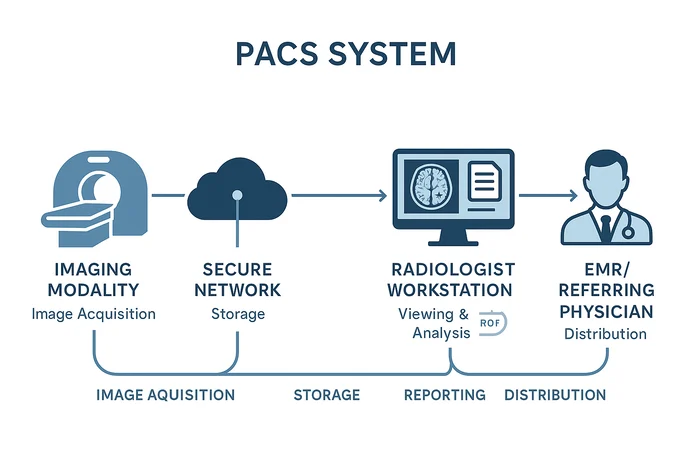
PACS, or Picture Archiving and Communication System, is a medical imaging technology that provides storage, retrieval, management, and distribution of radiology images electronically. It replaces traditional film-based storage, allowing radiologists, clinicians, and administrators to access imaging data digitally.
The core functions of PACS include:
Before PACS, hospitals often relied on film-based imaging and manual processes. This created numerous challenges:
| Challenge | Impact |
|---|---|
| Physical Storage Limitations | Film-based archives required large physical storage spaces, making retrieval time-consuming. |
| Delayed Report Delivery | Physicians waited hours or days for film-based imaging results, delaying patient care. |
| Poor Collaboration | Sharing imaging results between departments or hospitals was cumbersome and error-prone. |
| Data Loss Risks | Film can degrade over time or be misplaced, risking permanent loss of critical patient information. |
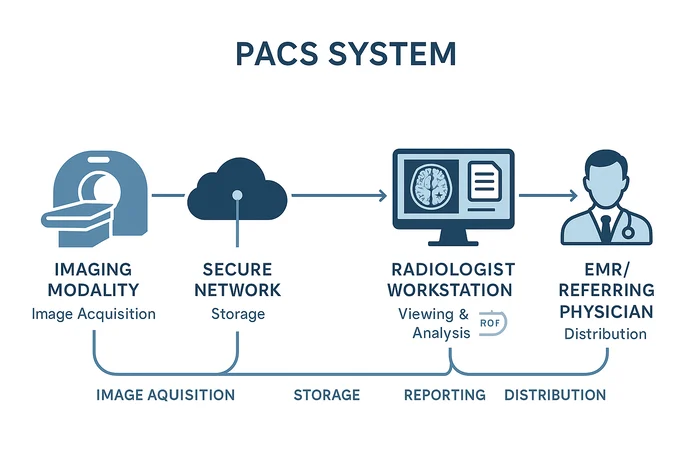
PACS has revolutionized the way radiology departments operate by addressing the challenges mentioned above. Here’s how:
PACS eliminates the need for physical film storage by digitizing medical images. All images are stored in a centralized system accessible from multiple locations, enabling radiologists and clinicians to retrieve data instantly.
With PACS, radiologists can review images and generate reports faster, reducing turnaround time and facilitating timely clinical decisions.
PACS enables seamless sharing of imaging data between departments, hospitals, and remote healthcare providers. This improves collaboration and ensures better patient outcomes.
PACS integrates with RIS (Radiology Information System) and HIS (Hospital Information System), creating a comprehensive ecosystem for patient data management. This eliminates redundant data entry and ensures data consistency across the hospital.
Modern PACS solutions allow authorized personnel to access imaging data remotely, making tele-radiology feasible. Specialists can review and interpret scans from anywhere, providing faster second opinions and expert consultations.
Modern PACS solutions offer advanced functionalities to optimize radiology workflows:
| Feature | Benefit |
|---|---|
| High-Resolution Digital Storage | Ensures accurate image quality for precise diagnosis. |
| Automated Workflow Management | Reduces manual tasks, improving efficiency in imaging departments. |
| Multi-Modal Support | Supports X-ray, MRI, CT, ultrasound, and more within a single platform. |
| Advanced Search and Retrieval | Quick access to patient records and historical imaging data. |
| Secure Access Control | Ensures patient data privacy and compliance with healthcare regulations. |
| Integration with RIS & HIS | Streamlines hospital-wide operations, eliminating duplication of work. |
| Analytics and Reporting | Helps track departmental performance, patient flow, and resource utilization. |
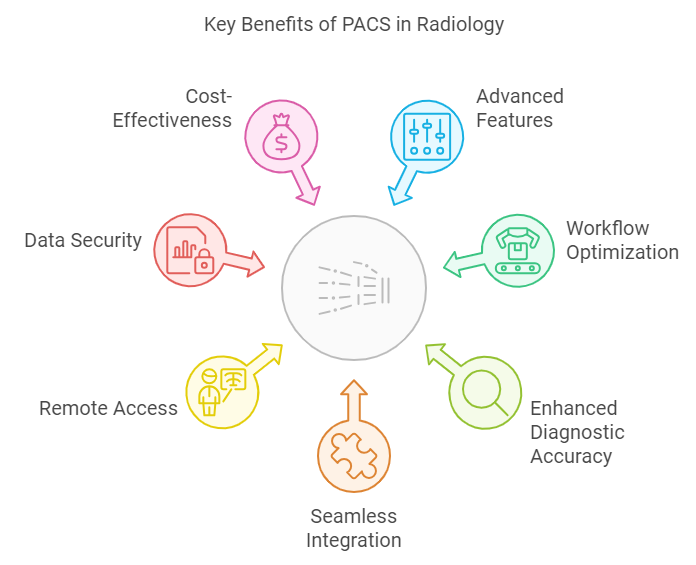
Implementing PACS provides numerous advantages:
A large hospital faced challenges with delayed imaging reports and inefficient collaboration between departments. After deploying BM Coder’s PACS solution:
| Before PACS | After PACS |
|---|---|
| Average report turnaround: 36-48 hours | Average report turnaround: 3-5 hours |
| Physical film storage occupied 5000+ sq. ft. | Digital storage reduced space usage by 95% |
| Sharing images required courier or CDs | Instant digital sharing with internal and external providers |
| Manual workflow caused errors and delays | Automated workflow minimized errors and optimized scheduling |
The hospital achieved faster diagnoses, higher patient satisfaction, and significant operational cost savings.

The PACS landscape is evolving rapidly with new innovations:
Selecting the ideal PACS solution requires careful consideration of your hospital’s unique needs:
| Criteria | Considerations |
|---|---|
| Scalability | System should support increasing patient volumes and additional imaging modalities. |
| Integration | Must work seamlessly with RIS, HIS, and other hospital systems. |
| User Experience | Intuitive interface for radiologists, technicians, and administrative staff. |
| Support and Maintenance | Reliable vendor support and ongoing software updates. |
| Compliance | Adherence to HIPAA, DICOM, and HL7 standards for security and interoperability. |
PACS Medical Imaging Systems have fundamentally transformed radiology departments, enhancing efficiency, improving diagnostic accuracy, and enabling better collaboration. Hospitals that adopt PACS solutions benefit from faster report turnaround, secure and accessible imaging data, and improved patient care.
BM Coder offers state-of-the-art PACS Medical Imaging Systems designed to optimize hospital workflows and improve radiology operations. Elevate your imaging capabilities today by contacting us via email or WhatsApp.
Author: parth
