
MSME
Registered

Wedline
Registered

We Deliver
Clutch

28+ Reviews

250+ Projects
Completed

125+ Happy
Clients
MSME
Registered
Wedline
Registered
We Deliver
Clutch
28+ Reviews
250+ Projects
Completed
125+ Happy
Clients
Date: 30-04-2026
By BM Coder — Enterprise Software Development Company
Manufacturing runs on thin margins. A single hour of unplanned downtime, a two percent defect rate, or a delayed raw material shipment can erase the profit from an entire shift. For decades, factories managed this complexity with paper logbooks, Excel sheets, whiteboards, and the experience of veteran supervisors.
Today, leading factories look very different. Machines report their health in real time. Production schedules adjust automatically when an order changes. Quality issues are caught by vision systems before a bad part leaves the line. Operators see work instructions on tablets, not printed binders. This is not magic. It is manufacturing software working across the shop floor, the plant, and the enterprise.
At BM Coder, we build these digital manufacturing platforms for discrete, process, and hybrid industries. Our approach is rooted in modern engineering practices, especially cloud native application development, which allows us to deliver manufacturing systems that scale across multiple plants, update without downtime, and integrate easily with machines, ERPs, and IoT devices. This cloud native foundation is what makes true efficiency and automation possible.
From MES and digital work instructions to predictive maintenance and OEE dashboards, we build manufacturing software that delivers ROI.
Email: [email protected]
WhatsApp: +91 95869 79730
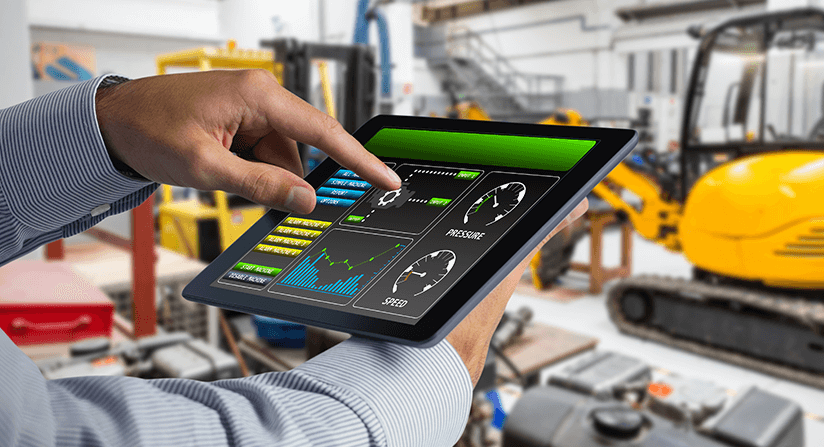
Manufacturing software is a suite, not a single tool. At the core is the Manufacturing Execution System, or MES, which tracks what is being made, where, by whom, and with what materials, in real time.
Around the MES are critical modules. Production planning and scheduling optimizes sequences to reduce changeovers. Quality Management System captures inspections, SPC data, and non conformances. Maintenance Management handles preventive and predictive tasks. Warehouse Management tracks raw material and finished goods. Andon and shop floor dashboards give operators instant visibility.
All of this connects upward to ERP for orders and costing, and downward to machines via PLCs, SCADA, and IoT sensors. When integrated correctly, data flows automatically from sensor to dashboard to decision, without manual entry.
| Area | Manual Approach | Manufacturing Software Approach | Typical Improvement |
|---|---|---|---|
| Production Tracking | Paper log, end of shift entry | Real time machine data, barcode scan | 95 percent data accuracy |
| Scheduling | Excel, supervisor experience | Finite capacity scheduling, auto sequencing | 15 to 25 percent higher throughput |
| Downtime | Reported after shift | Automatic detection, reason codes | 20 to 30 percent downtime reduction |
| Quality | Paper checklists, late detection | SPC, vision inspection, traceability | 50 percent reduction in defects |
| Maintenance | Breakdown or calendar based | Predictive, condition based | 30 percent lower maintenance cost |
| OEE Visibility | Calculated weekly | Live OEE by machine, line, plant | OEE lift from 55 to 75 percent |
Efficiency is measured by OEE, Overall Equipment Effectiveness, which combines availability, performance, and quality. Manufacturing software attacks all three.
Availability: Machines are connected via OPC UA or MQTT. The system detects stops automatically, prompts operators for reason codes on a tablet, and calculates true downtime. Pareto charts show top losses daily, not monthly. Maintenance teams fix root causes, not symptoms.
Performance: Cycle times are tracked for every part. If a machine runs slower than standard, alerts fire immediately. Scheduling software reduces changeovers by grouping similar jobs and optimizing tool paths. One automotive component client increased output by 18 percent simply by reducing setup time visibility.
Quality: Digital work instructions ensure standard work. Operators cannot skip steps. Inspection data is captured digitally and plotted on control charts. If a dimension trends toward limits, the line stops before defects occur. Full genealogy tracks which material lot went into which finished serial number, critical for recalls.
Automation is often confused with robots. Robots matter, but software automation delivers faster ROI. Key examples include automated data collection, automated quality checks, and automated material flow.
With machine integration, there is no manual production entry. Counts, rejects, and alarms flow directly from PLCs. Vision systems inspect 100 percent of parts at line speed, far beyond human capability. Automated guided vehicles receive move orders directly from the MES when a bin is full.
Workflow automation also removes paperwork. A non conformance automatically creates a CAPA, notifies quality, holds inventory, and updates ERP. A maintenance work order is created automatically when vibration exceeds threshold. These closed loops reduce lead time from hours to minutes.
Our cloud native application development approach makes this automation resilient. Microservices for data ingestion, rules engine, and notifications scale independently. If vision inspection load spikes, only that service scales, not the entire plant system.
| Module | Function | Key Technologies | Business Value |
|---|---|---|---|
| MES | Real time production tracking | OPC UA, MQTT, barcode, RFID | Live visibility, paperless shop floor |
| APS | Advanced planning and scheduling | Constraint solver, AI | Higher on time delivery |
| QMS | SPC, inspections, CAPA | Vision AI, digital forms | Lower scrap and rework |
| CMMS | Predictive maintenance | IoT sensors, ML models | Reduced breakdowns |
| WMS | Inventory and traceability | Barcode, AGV integration | Inventory accuracy over 99 percent |
| Energy Management | Monitor power, air, water | IoT meters, analytics | 8 to 12 percent energy saving |
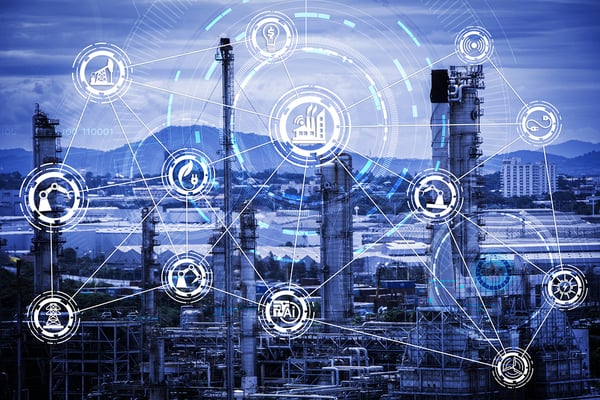
Industry 4.0 is the convergence of physical and digital. Manufacturing software is the nervous system.
Digital twins create virtual models of lines and factories. Engineers simulate changes before implementing them physically. IoT platforms collect thousands of signals per second from machines. Edge computing processes critical data locally for sub second response, while cloud aggregates for long term analytics.
AI models predict quality issues based on process parameters, recommend optimal machine settings, and forecast demand for better planning. Augmented reality guides operators through complex assembly with step by step overlays.
This is only possible with a modern architecture. Monolithic on premise MES cannot handle this scale and variety. Cloud native platforms with event streaming, data lakes, and API first design are essential.
Every efficiency gain starts with clean, contextualized data. Manufacturing software creates a unified namespace where every machine, sensor, and order has a standard name and model.
Data is collected at the edge, normalized, and published to a central event bus like Kafka. Historian databases store time series data for years. Analytics layers calculate OEE, MTBF, MTTR, first pass yield, and energy per part automatically.
Dashboards are role based. Operators see andon boards. Supervisors see shift performance. Plant heads see cost per unit. Executives see multi plant benchmarks. This transparency drives accountability and continuous improvement.
| Level | Characteristics | Typical Tools | Next Step |
|---|---|---|---|
| 1. Paper Based | Manual logs, Excel | Whiteboards, spreadsheets | Implement digital data collection |
| 2. Connected | Machine data, basic MES | OPC, dashboards | Add quality and maintenance modules |
| 3. Integrated | MES-ERP integration, traceability | APS, QMS, WMS | Deploy analytics and AI |
| 4. Intelligent | Predictive, autonomous, digital twin | AI, ML, AR, robotics | Scale across supply chain |
Factories have heterogeneous equipment, old machines with no digital output, multiple PLC brands, and legacy ERP. Integration is the hardest part.
Modern manufacturing software uses an integration layer with protocol adapters for Modbus, OPC UA, Siemens S7, Fanuc Focas, and MQTT. For old machines, we add low cost IoT sensors for current, vibration, and count. For human operations, we use tablets and barcode scanners.
Data models follow standards like ISA-95, ensuring consistency from shop floor to ERP. APIs allow easy connection to SAP, Oracle, or homegrown systems. This avoids vendor lock in and enables phased modernization.

Manufacturing systems cannot go down. They also cannot be breached. We design with Purdue model segmentation, with DMZ between IT and OT networks. Edge gateways buffer data if cloud connection fails, ensuring zero data loss.
Cloud native deployments use zero trust security, encrypted communications, role based access, and audit logs for every action. Updates are deployed as containers with blue green deployment, so production never stops. This reliability is why leading manufacturers choose modern architectures over legacy monoliths.
For a precision engineering client, we implemented MES with machine integration across 42 CNC machines. OEE increased from 58 percent to 76 percent in six months. Downtime reporting time dropped from 4 hours to real time. Paperwork was eliminated completely.
For a food processing plant, we built a traceability and quality system. Batch recall time reduced from 8 hours to 90 seconds. Giveaway reduced by 1.2 percent through automated weight control, saving over Rs 1.5 crore annually.
For a discrete manufacturer, our APS module reduced planning time from 6 hours daily to 20 minutes, while improving on time delivery from 82 percent to 96 percent.
We do not sell off the shelf licenses. We engineer solutions for your processes. Our process starts with a value stream mapping workshop on your shop floor. We identify top losses, data gaps, and quick wins.
We then build a modular platform using our manufacturing accelerator built on cloud native principles. Core services include data ingestion, OEE engine, traceability, and workflow automation. We customize dashboards, integrations, and mobile apps for your operators.
Our typical stack is React and Flutter for frontends, Node.js and Go for microservices, TimescaleDB and InfluxDB for time series, Kafka for streaming, and Kubernetes for deployment on AWS, Azure, or on premise. This architecture, proven in our cloud native application development practice, ensures your factory software scales from one line to twenty plants without rewrite.
We deliver in 12 week increments, with measurable KPIs for each phase, OEE, downtime, scrap, or throughput. We train your team and provide 24x7 support.
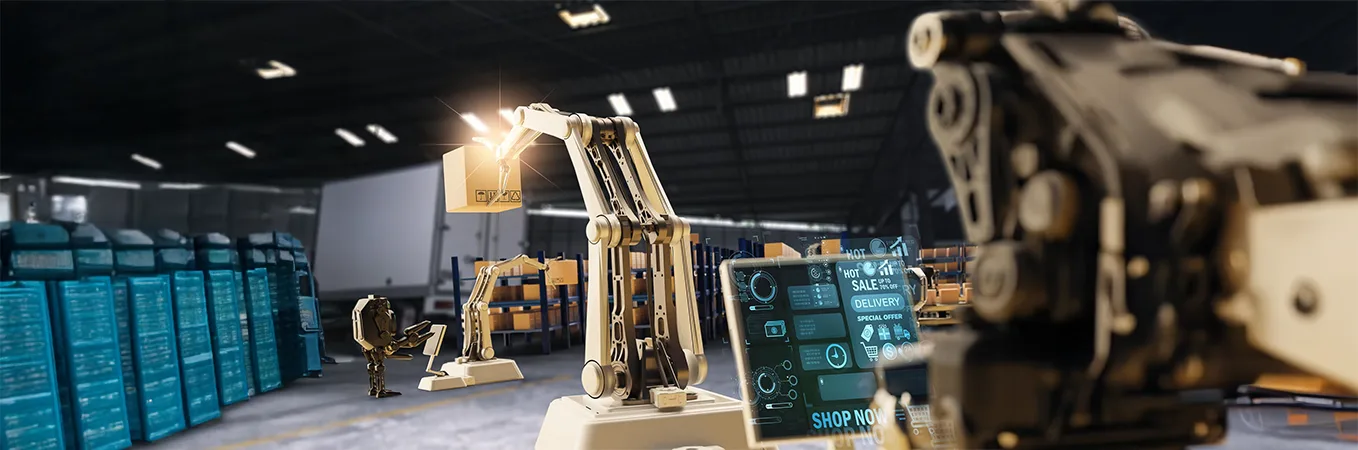
The next wave is autonomous manufacturing. AI agents will adjust machine parameters in real time to maintain quality. Generative AI will create work instructions from CAD files automatically. Collaborative robots will work safely alongside humans, orchestrated by software.
Sustainability will become core. Software will track carbon footprint per part, energy consumption per SKU, and water usage per batch, enabling green manufacturing and compliance with global standards.
Supply chain resilience will require multi plant visibility. Cloud native platforms will provide a single control tower across all factories and suppliers, enabling dynamic rerouting when disruptions occur.
Manufacturing software improves production efficiency and automation by turning invisible losses into visible data, manual processes into digital workflows, and reactive decisions into predictive actions. It increases OEE, reduces defects, lowers costs, and improves on time delivery.
The key is not just buying software, but implementing the right architecture, integrations, and change management. With a cloud native, API first approach, manufacturers can modernize incrementally while building a platform for Industry 4.0.
BM Coder partners with manufacturers to make this transformation real, measurable, and sustainable.
Schedule a free factory assessment. We will analyze your current losses and provide a 90 day roadmap for digital manufacturing.
Email: [email protected]
WhatsApp: +91 95869 79730
Author: parth
