
MSME
Registered

Wedline
Registered

We Deliver
Clutch

28+ Reviews

250+ Projects
Completed

125+ Happy
Clients
MSME
Registered
Wedline
Registered
We Deliver
Clutch
28+ Reviews
250+ Projects
Completed
125+ Happy
Clients
Date: 18-03-2026
Artificial Intelligence (AI) is no longer a futuristic concept in healthcare—it’s here, transforming hospital management and clinical workflows at a rapid pace. Hospitals are leveraging AI-driven software to optimize operations, improve patient outcomes, and streamline administrative processes.
BM Coder provides advanced AI-powered hospital management software designed to integrate seamlessly with existing healthcare systems. If your hospital is ready to harness AI to enhance efficiency and patient care, contact us via email or WhatsApp.

AI hospital management software combines artificial intelligence with hospital information systems (HIS) to automate routine tasks, provide predictive analytics, and optimize decision-making. Unlike traditional hospital management software, AI solutions can learn from data patterns, adapt over time, and provide actionable insights.
Some of the key functionalities include:
Hospitals face growing pressures to deliver high-quality care while managing costs, staff workloads, and regulatory compliance. AI addresses these challenges in several ways:
AI algorithms analyze historical patient data to predict potential complications, readmissions, and treatment outcomes. Hospitals can proactively intervene, improving patient safety and reducing healthcare costs.
AI helps in automating administrative tasks such as patient triage, appointment scheduling, and report generation, allowing clinical staff to focus on direct patient care.
AI-powered decision support tools assist doctors and administrators by providing data-driven insights, risk assessments, and treatment recommendations based on large datasets and medical literature.
Hospitals can optimize staffing, operating room schedules, and equipment utilization using AI algorithms, reducing wait times and improving operational efficiency.
| Benefit | Description | Impact on Hospital Operations |
|---|---|---|
| Predictive Patient Care | Anticipates patient risks and complications | Reduces readmissions, improves treatment outcomes |
| Workflow Automation | Automates scheduling, billing, and report generation | Frees clinical staff to focus on patient care |
| Resource Optimization | Efficient allocation of staff, beds, and equipment | Reduces operational bottlenecks and wait times |
| Data-Driven Decision Support | AI provides insights for treatment planning and management | Enhances clinical decisions and operational strategies |
| Inventory Management | Predicts supply needs and reduces stock-outs | Improves cost control and operational efficiency |
| Regulatory Compliance | Automated reporting for healthcare regulations | Reduces legal risk and ensures accurate documentation |
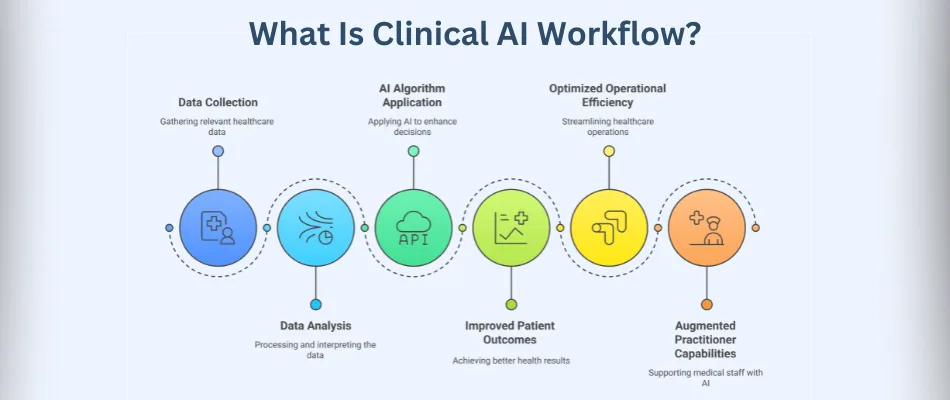
Clinical workflows benefit significantly from AI integration. Key areas include:
AI algorithms analyze medical images such as X-rays, CT scans, and MRIs to detect abnormalities faster and more accurately, assisting radiologists in making informed decisions.
By analyzing patient data, AI can recommend personalized treatment protocols, considering medical history, genetics, and predictive outcomes.
AI-powered triage systems prioritize patients based on severity and risk factors, while continuous monitoring tools track vital signs and alert clinicians to potential emergencies.
AI enhances telemedicine platforms by providing chatbots for initial patient assessments, predictive risk scoring, and remote monitoring capabilities.
| Feature | AI-Powered System | Traditional System |
|---|---|---|
| Patient Data Analysis | Predictive analytics for proactive care | Manual analysis and historical record review |
| Workflow Automation | Automated scheduling, billing, and reporting | Manual processes prone to delays |
| Clinical Decision Support | AI-assisted recommendations for diagnostics and treatment | Relies solely on clinician experience and reference materials |
| Resource Allocation | Optimizes staff, beds, and equipment usage | Manual adjustments, often inefficient |
| Regulatory Compliance | Automated reporting and alerts | Time-consuming manual compliance tracking |
| Hospital | Challenge | AI Solution | Outcome |
|---|---|---|---|
| City General Hospital | High readmission rates | AI predictive analytics for early risk detection | Reduced readmissions by 25%, improved patient outcomes |
| Metro Health Clinic | Manual scheduling and resource allocation delays | AI-powered scheduling and staff optimization | Improved efficiency by 40%, reduced wait times |
| Sunrise Medical Center | Imaging analysis delays in radiology | AI-assisted image diagnostics | Diagnosis time reduced by 50%, improved accuracy |

AI is revolutionizing hospital management and clinical workflows by automating processes, improving patient care, and enabling data-driven decision-making. Hospitals adopting AI solutions gain efficiency, reduce costs, and enhance patient satisfaction while staying compliant with healthcare regulations.
BM Coder delivers AI-powered hospital management software that transforms operations and supports clinical excellence. Take the first step toward AI integration by contacting us via email or connecting directly on WhatsApp.
Author: parth
