
MSME
Registered

Wedline
Registered

We Deliver
Clutch

28+ Reviews

250+ Projects
Completed

125+ Happy
Clients
MSME
Registered
Wedline
Registered
We Deliver
Clutch
28+ Reviews
250+ Projects
Completed
125+ Happy
Clients
Date: 01-05-2026
By BM Coder — Enterprise Software Development Company
For decades, software automated repetitive tasks based on fixed rules. If this, then that. Business intelligence meant dashboards showing what happened last quarter. Humans did the thinking, software did the recording.
AI-driven software changes this fundamentally. It learns from data, predicts outcomes, makes decisions, and automates complex workflows that previously required human judgment. A customer support bot resolves 70 percent of tickets without human intervention. A sales platform predicts which deals will close with 85 percent accuracy. A manufacturing system detects defects invisible to human eye.
This transformation is not about adding a chatbot. It is about embedding intelligence into core business processes. At BM Coder, we build these AI-driven platforms for enterprises. Success requires more than models, it requires connecting AI to real business systems, data, and workflows. That is why our AI implementations are built on strong foundations of enterprise system integration, ensuring AI can access ERP, CRM, and operational data securely to deliver actionable automation and intelligence.
We develop AI solutions for automation, prediction, and business intelligence across industries.
Email: [email protected]
WhatsApp: +91 95869 79730
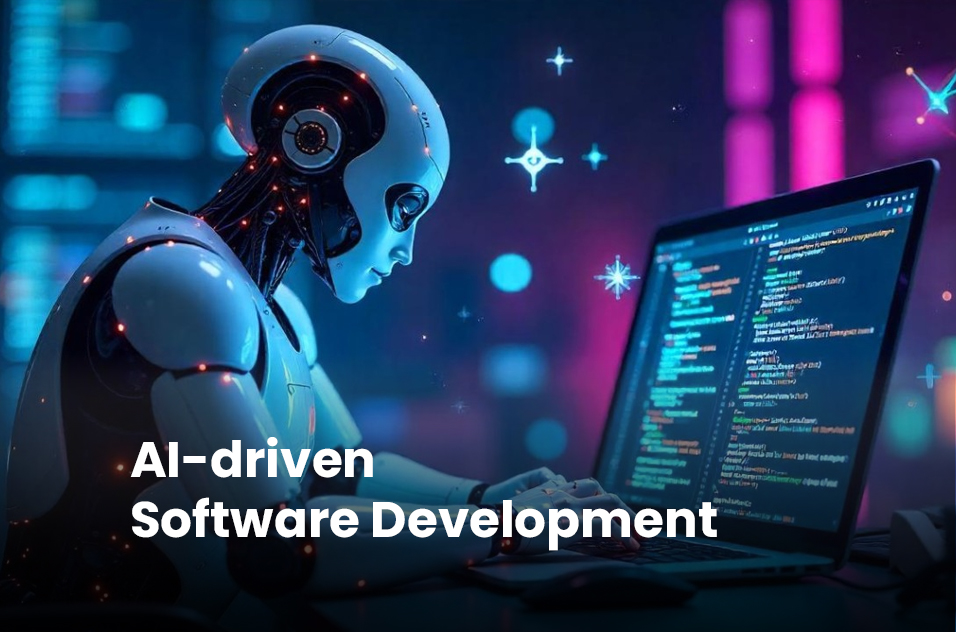
AI-driven software uses machine learning, natural language processing, computer vision, and generative AI to perform tasks that traditionally required human intelligence.
Unlike rule based automation, AI systems improve over time as they see more data. They handle ambiguity, understand context, and make probabilistic decisions. They can read documents, understand images, predict demand, and generate content.
The key shift is from descriptive to predictive and prescriptive. Instead of showing what happened, AI tells you what will happen and what to do about it.
| Capability | Traditional Software | AI-Driven Software | Business Impact |
|---|---|---|---|
| Automation | Rule based workflows | Learns from data | Handles exceptions automatically |
| Decision Making | Human driven | Model assisted | Faster, consistent decisions |
| Data Analysis | Dashboards, reports | Predictions, anomalies | Proactive action |
| Customer Interaction | Forms, menus | Natural language | Better experience |
| Adaptability | Requires code changes | Learns continuously | Reduces maintenance |
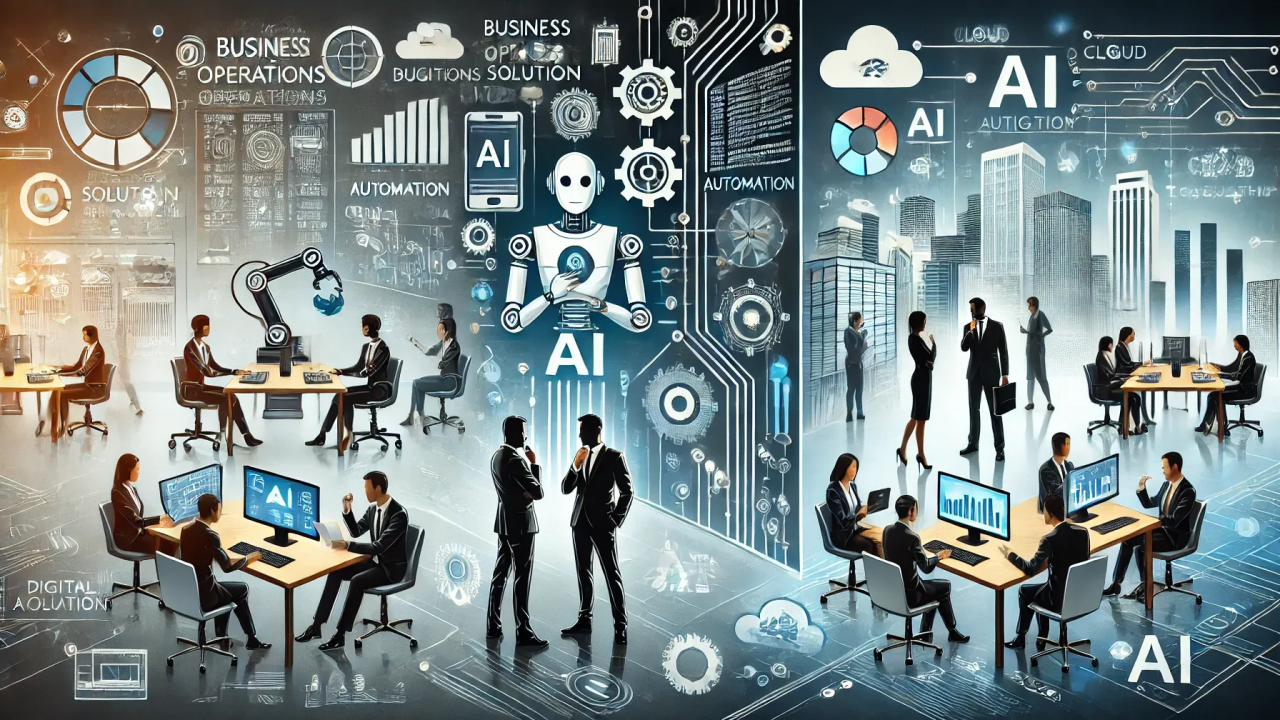
Traditional RPA automates clicks. AI-driven automation understands content.
Intelligent Document Processing: AI reads invoices, contracts, and forms with 95 percent accuracy, extracting data even from unstructured layouts. Accounts payable processing time drops from days to minutes.
Conversational Automation: AI agents handle customer queries, schedule appointments, and process returns using natural language. They understand intent, not just keywords.
Process Mining: AI analyzes system logs to discover actual workflows, identify bottlenecks, and suggest automation opportunities humans miss.
Hyperautomation: Combining AI, RPA, and APIs to automate end to end processes across systems. For example, customer onboarding that extracts data from ID, verifies KYC, creates accounts in CRM and ERP, all automatically.
Traditional BI answers what happened. AI-driven BI answers why, what next, and what if.
Predictive Analytics: Forecast sales, demand, churn, and equipment failure with high accuracy. Retailers reduce stockouts by 30 percent using demand forecasting.
Anomaly Detection: AI monitors thousands of metrics and flags unusual patterns instantly. Fraud detection, quality issues, and system failures are caught in real time.
Natural Language BI: Business users ask questions in plain English, what were top products last month in Mumbai, and get instant charts and insights without SQL.
Prescriptive Analytics: AI recommends actions, increase price by 5 percent, reorder inventory now, offer discount to this customer segment, with expected impact.
| Function | AI Application | Technology | ROI Example |
|---|---|---|---|
| Customer Service | AI chatbots, sentiment analysis | LLMs, NLP | 60 percent ticket deflection |
| Sales | Lead scoring, forecasting | ML classification | 25 percent higher conversion |
| Operations | Predictive maintenance | Time series models | 40 percent less downtime |
| Finance | Invoice processing, fraud | OCR, anomaly detection | 80 percent faster processing |
| HR | Resume screening, attrition | NLP, predictive models | 50 percent faster hiring |
| Marketing | Personalization, content generation | Generative AI | 3x engagement |
Effective AI systems require data pipelines, model serving, and integration layers.
Data ingestion from multiple sources via our enterprise system integration capabilities ensures AI has clean, unified data. Feature stores provide consistent features for training and inference. Model registry manages versions. MLOps pipelines automate retraining and deployment.
Inference can be real time for chatbots or batch for forecasting. Monitoring tracks model drift and performance degradation.

Large Language Models: GPT and open source models for text understanding and generation. Used for chatbots, summarization, and code assistance.
Computer Vision: For quality inspection, document processing, and visual search.
Predictive ML: XGBoost, Prophet, and neural networks for forecasting and classification.
Generative AI: Creates content, designs, and synthetic data.
| Phase | Focus | Activities | Outcome |
|---|---|---|---|
| 1. Identify | High value use cases | Process analysis, ROI estimation | Prioritized backlog |
| 2. Data | Data readiness | Integration, cleaning, labeling | Quality dataset |
| 3. Pilot | Proof of value | Build MVP model | Measurable ROI |
| 4. Production | Scale and integrate | MLOps, monitoring | Business impact |
Data Quality: AI is garbage in garbage out. Invest in data pipelines and governance.
Integration: AI must connect to existing systems. Strong integration architecture is critical.
Trust: Explainable AI and human in the loop build confidence.
Change Management: Train teams to work with AI assistants, not fear them.
We start with business problem, not technology. We assess data readiness and identify quick win use cases. We build MVPs in 6 to 8 weeks to prove value.
We implement full MLOps with monitoring and retraining. We integrate AI into existing workflows via APIs and UI components. We ensure security, privacy, and compliance.
Our solutions combine AI models with robust enterprise integration to deliver real business outcomes.
Track metrics like automation rate, time saved, accuracy improvement, revenue lift, and cost reduction. One manufacturing client achieved $2.3M annual savings from predictive maintenance alone.
Agentic AI that performs multi step tasks autonomously. Multimodal AI combining text, image, and voice. AI copilots embedded in every business application. Small specialized models running at edge.
AI-driven software is transforming automation from rule based to intelligent, and business intelligence from descriptive to predictive and prescriptive. Organizations that embed AI into core processes gain significant competitive advantage through speed, efficiency, and insight.
Success requires not just models, but data, integration, and change management. BM Coder helps you navigate this transformation end to end.
Contact BM Coder for AI strategy workshop and pilot development.
Email: [email protected]
WhatsApp: +91 95869 79730
Author: parth
